
Luce County Court Records After Arrest
The arrest-to-court path in Luce County starts with a booking record but does not end there. A booking charge records what led to custody. The formal court record starts when the Luce County Prosecutor's Office authorizes or files charges. Those charges may differ from the booking language because prosecutors can amend counts, decline counts, add counts, or file a felony path that begins in district court and moves to circuit court. The court record is the better source for filed charges, hearings, bond orders, plea status, dismissal, conviction, and sentence.
Custody and court records answer separate questions. For jail location, booking, and release status, use Luce County jail inmate records. For booking photos, use the Luce County jail mugshots record path. For court records after a jail arrest, start with the official court systems and the court offices that handle criminal cases in Luce County.
Search Luce County Court Records
The official statewide portal is MiCOURT Case Search. The portal is dynamic, so every live search option may not be visible until the search interface loads, but it remains the correct starting point for public court case lookup where a Luce County case is available online. Search after arraignment or prosecutor filing, since a very fresh arrest may not yet have a visible public case. If the case does not appear, call the court that fits the stage of the case.
- Open MiCOURT Case Search and select the court or county filters when the live portal offers them.
- Search by defendant name, case number, case type, or date range if those fields are available.
- Open the matching criminal case and read the charge list, charge level, event history, and hearing dates.
- Confirm bond, warrant, plea, dismissal, or sentence details with the court if the online docket is unclear.
The MiCOURT landing interface is the official court-search start for public case records.
MiCOURT Case Search provides the statewide case-search portal used for Luce County court records after an arrest:
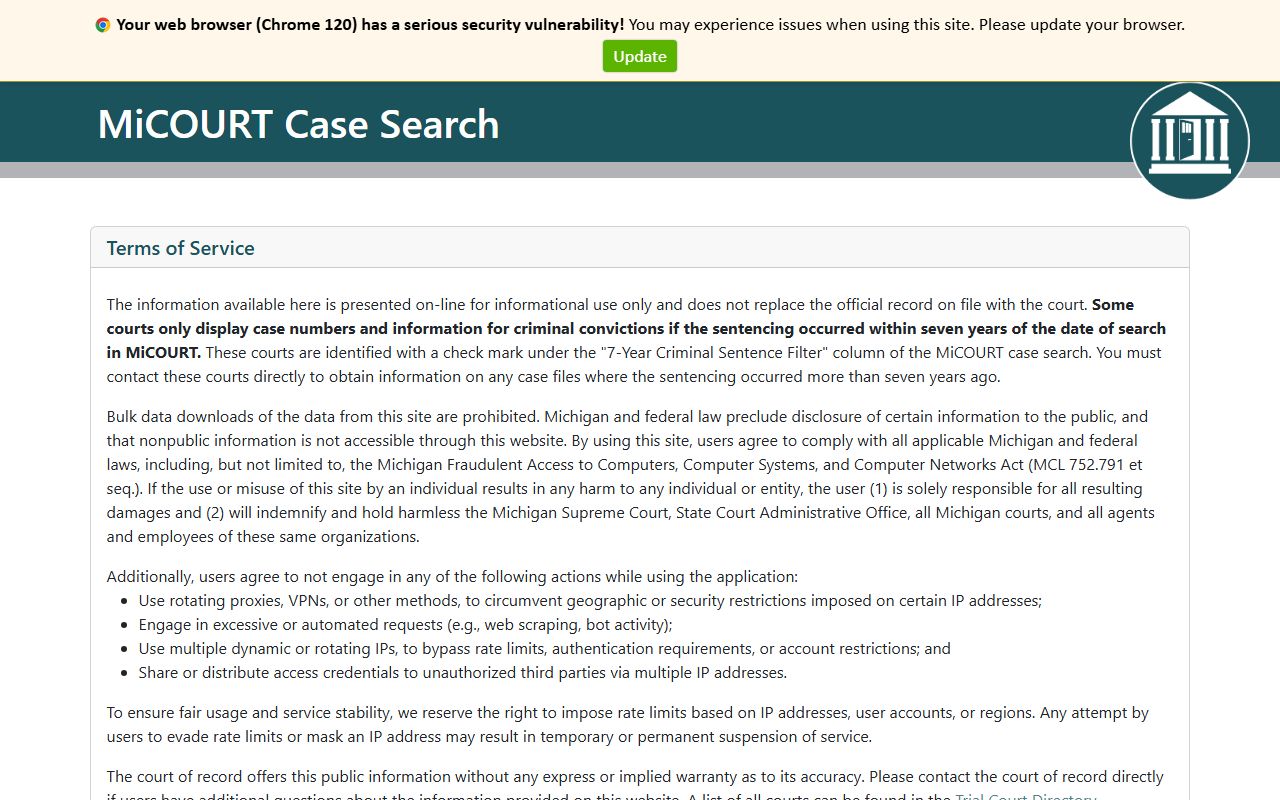
Use the portal for filed court records, then use the district or circuit court contact when the online record is missing, sealed, delayed, or ambiguous.
Luce County Arrest Court Path
The 92nd District Court handles misdemeanors punishable by not more than one year in jail, including arraignment, sentence, and setting and acceptance of bail. It also conducts preliminary examinations in felony cases. The 11th Circuit Court handles circuit-level matters after felony movement and lists MiFILE and court payment resources. In practical terms, a felony arrest may begin in district court for early events and move to circuit court if bound over or otherwise filed there.
| Court or Office | Role After Arrest | Use It For |
|---|---|---|
| 92nd District Court | Early criminal process | Arraignment, misdemeanor case status, bail, and felony preliminary examinations. |
| 11th Circuit Court | Circuit criminal process | Felony case movement after bindover or circuit filing. |
| Luce County Prosecutor's Office | Charging authority | Filed charges, amended counts, victim advocate routing, and charging-office context. |
| MSP ICHAT | Criminal-history search | State criminal-history records, subject to major exclusions. |
Luce County Case Search Fields
A court record search is strongest when the case number is known. If it is not known, use full legal name, spelling variants, the date of arrest, and the court likely to hear the case. A common error is to search ICHAT first and assume it is a live docket. The Michigan State Police criminal history records page says ICHAT excludes warrant information, federal records, tribal records, traffic records, juvenile records, local misdemeanors, and out-of-state history.
| Field Label | Type | Required | Notes |
|---|---|---|---|
| MiCOURT case search | Web portal | Unspecified | Search by party, name, case number, and court where available. |
| Court | Dropdown or filter | Depends on portal | Select Luce County, 92nd District, or 11th Circuit when available. |
| Case number | Text | Optional | Best search key if known from citation, complaint, bond paperwork, or notice. |
| Party or defendant name | Text | Optional | Use legal name and spelling variants. |
| Case type | Dropdown or filter | Optional | Availability depends on court and case category. |
| Date range | Date filter | Optional | Useful when the arrest date is known. |
Luce County Charging Records
After a jail arrest, the charging document is the point where an accusation becomes part of the court case. The prosecutor may use a complaint to start the case, an information after preliminary steps in a felony matter, or an indictment in a grand-jury case. Local Michigan practice more often turns on complaint and information records than on local grand-jury indictment records, but all three terms are useful when reading court records after an arrest.
| Document | Filed By | Common Use | What It Shows |
|---|---|---|---|
| Complaint | Prosecutor, often based on police facts | Begins many criminal cases | Alleged offense, defendant, basic facts, and charge language. |
| Information | Prosecutor | Many felony cases after preliminary process | Formal felony counts that proceed in circuit court. |
| Indictment | Grand jury | Less common in local practice | Grand-jury charging decision and counts. |
Luce County Charge Status
Charges can change after a jail arrest. A booking charge may be replaced by a filed charge. A count can be amended, reduced, dismissed, held for preliminary examination, bound over, resolved by plea, or tried. The online docket may also lag behind a hearing. If a status affects bond, custody, travel, employment, or family planning, confirm it with the court clerk or counsel rather than relying on a stale search result.
| Status | What It Means |
|---|---|
| Pending | The charge is open and has not reached final disposition. |
| Amended | The prosecutor or court record changed the charge language or count. |
| Reduced | The charge moved to a lower offense level or different count. |
| Dismissed | The charge was dropped by court order or prosecutor action. |
| Convicted | A plea or verdict resulted in guilt on the count shown. |
Luce County Bond Records
Bond is part custody record and part court record. The district court source states that 92nd District Court handles setting and acceptance of bail for misdemeanor criminal cases and conducts felony preliminary examinations. A jail may know whether a person can be released, but the court order controls the type and terms. Always confirm the amount, bond type, accepted payment path, release conditions, and any outside hold before paying.
| Bond Type | How It Works |
|---|---|
| Cash bond | Money is paid as ordered by the court, subject to release conditions and any holds. |
| Surety bond | A surety or bond agent may post where allowed and accepted. |
| Personal recognizance | Release is based on a promise to appear and comply with conditions. |
| No-bond hold | The person cannot be released by paying a local money bond. |
| Detainer | Another agency's hold may block release even if local bond is handled. |
Luce County Arrest Warrants
No official Luce County active-warrant search or sheriff warrant list was located. That means warrant checks should use a direct confirmation path. Call the Luce County Sheriff's Department for local warrant or surrender questions, 92nd District Court for bench warrants tied to district matters, and 11th Circuit Court for circuit-level warrant questions. ICHAT is not a warrant search. A defense attorney can also confirm status and help arrange a court appearance or surrender plan.
- Bench warrant
- A court warrant often issued after a missed hearing or violated court order.
- Arrest warrant
- A warrant authorizing arrest for a suspected offense.
- Detainer
- A hold from another agency that may affect release.
- Remand
- A court order keeping a person in custody.
Luce Charges vs Convictions
A charge is an accusation. A conviction is the result of a guilty plea, guilty verdict, or other final adjudication that creates a criminal-history outcome. Court records after a Luce County jail arrest may show charges that later change or disappear. Read the docket history and disposition, not just the first charge line.
| Charge | Conviction | |
|---|---|---|
| Stage | Accusation filed in court | Final result after plea or verdict |
| Proof level | Probable cause or charging standard | Beyond reasonable doubt or admitted by plea |
| Record meaning | Shows what was alleged | Shows a proven or admitted offense |
Luce Sealed and Expunged Records
Michigan public access is shaped by FOIA, court rules, Clean Slate relief, and criminal-history statutes. MCL 28.243 addresses expungement or destruction of arrest records, biometric data, fingerprints, and LEIN charge entries in qualifying circumstances. MCL 15.243 also allows withholding or redaction of certain records under FOIA exemptions. A sealed, nonpublic, juvenile, suppressed, or expunged matter may not appear in public search results.
| Sealed | Expunged or Set Aside | |
|---|---|---|
| Public visibility | Hidden from public access in whole or part | Removed, destroyed, or treated under set-aside rules when eligible |
| Agency access | May remain available to specified justice users | May still have limited lawful access depending on rule and record type |
| How to confirm | Contact the court clerk or counsel | Use the court order or statutory process that applied |
Luce Court Records and ICHAT
MSP ICHAT can help with statewide public criminal-history checks, but it should not be confused with a live court docket. The MSP page states that ICHAT excludes several categories, including warrants and local misdemeanors. Use court records for case events and ICHAT only for the criminal-history coverage MSP describes. For employment, tenant screening, credit, insurance, or similar decisions, use lawful consumer-reporting channels instead of informal inmate or court lookup pages.
Important: Informal court and custody searches are not consumer reports and must not be used for FCRA-covered decisions.
Restricted Luce Arrest Court Records
Some court records after an arrest may be delayed or unavailable to the public. Juvenile matters, sealed cases, expunged records, suppressed records, victim-sensitive information, and ongoing investigative material can be withheld or redacted. The Michigan FOIA Act gives access to certain public records of public bodies, but it does not make every police, jail, prosecutor, or court-adjacent record public on demand. Use the court clerk for docket access and the Luce FOIA process for county records outside the court file.